
AgentStack — Enforcement matrix
Current as of agentstack 0.19.0.
Short codes below (W2,W4,D3,D4,G9,Phase 1–Phase 4) name internal development milestones, not public releases or CVE-style identifiers. They record when a behaviour landed relative to other work inTODO.md; nothing in this document depends on knowing them, and every claim beside them stands on its own.
This is the authoritative, code-grounded answer to one question: for each execution mode, what does AgentStack actually enforce, and by what mechanism? When any other document and this one disagree, this one is right: it is checked against the source, not against intent.
Audience: anyone deciding what a mode actually guarantees.
Contents
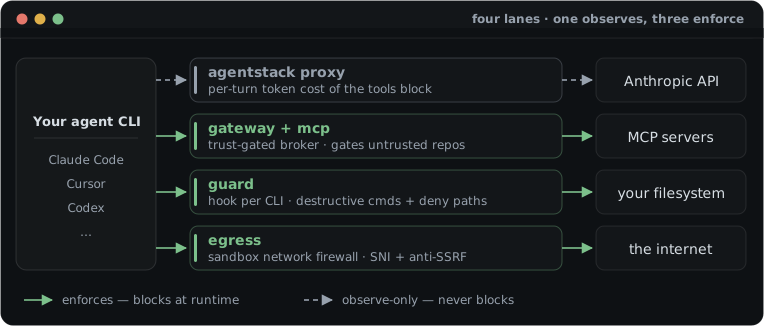
AgentStack intercepts an agent CLI on four independent lanes (one observes, three enforce):
Claim discipline#
AgentStack restricts destinations and records decisions; it cannot guarantee that sensitive content never leaves through an allowed destination. An enforced egress allowlist blocks connections to hosts you did not approve. It does not inspect payloads, and it permits traffic to every host you did approve, including the model API itself. A prompt-injected agent can still exfiltrate through any allowed channel. The honest claim is: untrusted project declarations are not auto-activated, and unapproved egress is blocked on the enforced paths, never "exfiltration is impossible."
Read every cell below with that ceiling in mind. "Enforced" means the disallowed action is prevented at runtime (by the kernel, the container boundary, or the proxy); it never means the allowed action is safe.
What "trusted" does and does not mean#
Trusting a project asserts exactly one thing: the current manifest, local overlay, and lockfile consent digest was approved for automatic loading on this machine. The lockfile separately pins resolved server definitions, skills, and instructions; drift in those inputs fails verification. Detached signatures attest to lockfile bytes but do not silently create local trust.
Trusted does not mean:
- Safe to run unsandboxed. Trust gates whether a bundle's servers spawn, its skills enter context, and its secrets resolve. It does not confine what a running agent then does. That is the job of policy and the sandbox, per the matrix below.
- Vetted for correctness or intent.
agentstack trustsummarizes the runtime surface (commands, HTTP contacts, secret refs, and skill pin status) so you can judge it. AgentStack verifies the consent digest and lock pins; it does not vouch for what the referenced code does. - Tamper-proof against a compromised host agent. In host mode the agent CLI runs as you, so it can in principle reach the user-writable trust store under
~/.agentstack/and self-trust a bundle. Only the sandbox removes this. The interactive consent probe is part of the same limit:isatty(stdin)proves stdin is a terminal device, never that a human is reading it, and a same-user process that allocates a pseudo-terminal (script,expect, aptywrapper) reads as interactive. Because of that, no grant depends on the probe:--yesrequires--consented <digest>everywhere, terminal or not, so the probe decides only whether a human is prompted, the one question it can answer. Every store mutation leaves an identity-only event behind (see Trust-store mutation logging), which makes silent self-trust harder to miss, but the log lives in the same user-writable directory, so it is evidence, not a defence.
The resident agent#
The threat this section is really about is not a distant attacker: it is the agent already running here, in a hooked harness, on your account, holding the same shell and the same file tools you hold. Every flag the CLI accepts is a flag it can type, and inside the process a trust . --yes --consented <digest> from that agent is indistinguishable from the same command typed by a human who read the preview. The hook is the last place that difference still exists, so that is where the refusals live.
What the guard refuses, on the everyday path (agentstack guard check, wired as each CLI's pre-tool-use hook):
- the grant, typed.
agentstack trust(except its read-only--previewand--list),agentstack yes, and the promptlessinit --yes/apply --yesare denied from an agent shell, in the wrapped and quoted spellings too (sudo …,sh -c "…"). Everything elseagentstackdoes (status, preview, lock, render, undo) stays allowed; - the store, from an interpreter. A
python*/node/ruby/deno/bun/php/perl -eprogram whose text names.agentstackorAGENTSTACK_HOMEis denied. The inline program is opaque to every path check the guard has, so this one is textual and coarse, the right trade in exactly one directory, the one where a false negative forges a human's consent; - the store, from a file tool.
~/.agentstackis unwritable by Write / Edit /apply_patchas well as by the shell, and[guard] allow_rootscannot allowlist it even when set to the whole home directory. The older exemption ("a harness shows those diffs to the user") holds for a manifest in a workspace and is worthless for the file that records a consent ceremony.
Alongside those, a scripted agentstack init --yes no longer records trust by itself: --yes acknowledges the write, and consent for what the imported servers run comes either from the wizard's own confirm or from --consented <plan_digest> after init --plan. The import completes and the project stays untrusted, which the close says in as many words.
What remains, stated plainly:
- interpreter creativity beyond the pattern. A program can assemble the path from pieces the text check never sees. The check closes the spelling anyone actually writes, not the space of all spellings;
- hookless harnesses. All of the above is cooperative: a harness that never consults its own hook protocol, or an agent invoked outside one, is outside every refusal here. The kernel-enforced story is
run --sandbox/--lockdown; - same-user OS access. A process running as you can answer a prompt it allocated, or write
trust.jsondirectly. The real boundary is the OS user account; nothing in this section claims otherwise. What these gates remove is the ordinary path: the agent with a tool loop, typing the flag.
crates/cli/tests/red_team_agent_self_consent.rs is the witness for the five doors above, driven through the hook binary and the real grant path.
Conversely, untrusted project declarations are inert on automatic and experimental execution paths: the auto-project gateway does not spawn or contact their MCP servers or resolve their secrets, and tools_execute refuses to begin. Since the write gate reached all five capability kinds, an explicit static agentstack apply --write is blocked too: it renders no server config, no skills, no instruction fragments, no hooks and no extensions for a project that is untrusted or drifted. What this still does not do is sandbox arbitrary repository code or prevent a user from running it by hand. Those are separate authorization and execution paths, and a harness that reads bytes already on disk starts them outside agentstack entirely.
Policy is authority, not isolation#
Policy decides which tools, hosts, secrets, and paths are permitted; it does not decide where the process runs. Policy is not a sandbox: an allowed tool can still have side effects, and an allowed host can still receive sensitive data. Confinement is the job of --sandbox and --lockdown, per the matrix below; the two compose but are never substitutes.
The shipped presets (examples/policies/) map to intent, not to a single universal mode: use developer for daily work, compatible as a migration step from an unmanaged setup, locked-down when a run needs confinement, and ci as a runner-only floor. In every case the effective ruleset is the machine ∩ project intersection, so a preset can only narrow what the machine ceiling already allows.
The matrix#
Modes are columns; policy dimensions are rows. Legend:
- enforced — a runtime mechanism prevents the disallowed action; bypass means defeating the kernel, the container, or the proxy.
- coarse — a real check runs, but at coarser granularity than the policy can express (whole-workspace mount vs. per-path; host-only at write time vs. exact host:port at runtime; once-at-construction vs. per-call).
- unsupported — no code path on this mode consults the policy for this dimension; the dimension has no effect here. (Stated bluntly rather than softened to "advisory": for these cells no check happens at all, so there is nothing to bypass.)
- cooperative — a real per-call check runs, but only because the harness chooses to consult it (a pre-tool-use hook). Protects against an agent's accidents; a harness that ignores its own hook protocol, or a process the harness never routes through hooks, bypasses it entirely. Strictly weaker than enforced and never to be described as enforcement.
| Dimension | host | gateway | lease | --sandbox | --lockdown |
|---|---|---|---|---|---|
| Tools | unsupported | enforced | enforced◇ | enforced† | enforced |
| Egress | coarse | coarse | coarse | enforced* | enforced |
| Secrets | enforced | enforced | enforced | enforced‡ | enforced |
| Filesystem — write | cooperative¶ | cooperative¶ | cooperative¶ | coarse | coarse |
| Filesystem — read | cooperative¶ | cooperative¶ | cooperative¶ | coarse | coarse |
| Audit / recording | unsupported | enforced | enforced◆ | enforced§ | enforced |
| Native extensions | unsupported‖ | unsupported‖ | n/a◈ | unsupported‖ | unsupported‖ |
| Hooks | unsupported⁂ | unsupported⁂ | n/a◈ | unsupported⁂ | unsupported⁂ |
◇ the strongest tools cell, and fenced on top. A lease is the gateway column's dispatch path with one addition: the toolset. Every capability call still goes through Gateway::try_call, which applies the compiled machine ∩ project tool policy and re-checks the consent digest before the upstream is dialled, and on top of that, only the leased toolset's members are reachable. With no lease open, a project that declares toolsets serves control-plane tools only: the implicit union of everything declared is never served, because capability exposure requires an explicit selection. Opening a lease exposes exactly that toolset's members and nothing more; closing it returns the connection to control-plane tools. What the fence does not do is constrain what an allowed tool then does (see ◆).
◆ every brokered MCP call recorded — not "every call recorded". Each call the lease dispatches lands in calls.jsonl (and a run's events.jsonl inside a run) with digest-only arguments. That is evidence of the request: AgentStack records what was asked of a server, and cannot observe what that server then did internally. Recording is not prevention (a recorded call already happened), and an allowed destination can still exfiltrate, as the claim-discipline section above states for every column. A lease also does not make a call reproducible: only the pinned bytes in the lock do that.
Two further limits belong here, not in a footnote. A lease is process-scoped: it belongs to the MCP process that opened it and disappears with that process, so it is not a durable grant and cannot be re-attached to. And the delivery claim is "0 project artifacts for gateway-delivered capabilities", never a bare "0 files": a project in this lane still holds .agentstack/agentstack.toml, agentstack.lock, and, whenever instructions are used, a managed region in an instruction file. Those are rendered-lane artifacts and they are real.
◈ not applicable — these kinds never enter this lane. Native extensions and hooks are executable capability kinds: their code runs inside (or around) the harness process at full user permission. They are delivered by rendering files, never over a lease, so there is no lease cell to label. The full consent ceremony always applies to them, in a package or out of one, and no compressed-consent path may ever cover them. Their real story is the ‖ and # notes below.
* for proxied traffic only. Plain --sandbox points HTTPS_PROXY at the proxy but the container keeps an ordinary bridge network. A process that ignores the proxy env can still dial out directly. The run is labelled SANDBOX / PROXIED · DIRECT ROUTE OPEN for this reason; only --lockdown (no direct route, topological confinement) earns ENFORCED. See the egress section below.
† plain sandbox, for MCP traffic routed through the gateway. A trusted run renders one host-gateway entry into the harness config, so calls hit Gateway::try_call. Plain --sandbox still has an open direct route: an agent that independently reaches an egress-allowed upstream can bypass that gateway. An untrusted bundle, a bundle with no proxied servers, or an incompatible adapter can also be unrouted; those cases are surfaced at runtime. Under --lockdown, D4 closes this qualification: the same frozen, pin-verified server set drives gateway dispatch and the gateway_only_hosts egress fence; direct connections to every declared HTTP MCP host are denied even when ordinary egress policy allows them. If the gateway entry and native-config shadows cannot be installed, lockdown refuses to start. Undeclared service aliases are outside this exact declared-endpoint claim.
‡ plain sandbox, for gateway-routed runs. The host-side gateway resolves ${REF} secrets in its own memory and hands the container only the endpoint URL + a per-run bearer token: resolved secret values never enter the container. A prior agentstack apply that baked secrets into a project config is shadowed out. (A run that isn't gateway-routed falls back to the coarse rendered-config path.)
§ plain sandbox, for gateway-routed runs. A gateway-routed run's own events.jsonl gains a ToolCall per call (digest-only args) and a SecretAccess per resolved ref (name only), alongside the lifecycle + egress events it already held. Trust-store mutations and cost/tokens remain unrecorded. See the Audit / recording section.
‖ runtime is unsupported in every mode — this is a pre-delivery capability, not a runtime one. A native extension's code runs inside the harness process at full user permission; no policy ceiling, gateway, egress fence, container, or guard hook observes or constrains it once the harness loads it, so there is no runtime cell to earn a stronger label. What agentstack governs happens entirely before delivery: the source is content-pinned in agentstack.lock, an untrusted or drifted project renders zero bytes, apply copies (never symlinks) the pinned bytes into the harness's extension directory, and a protected run re-verifies each delivered copy against its pin before launch. That pipeline is provenance and content binding (which bytes, from where, reviewed by whom), not runtime enforcement, and it is labelled as such. See the Native extensions section.
⁂ runtime is unsupported in every mode — a hook is a command the harness itself runs at full user permission. A [hooks.*] entry compiles into each hook-capable harness's native hooks config; when the harness fires the event, it executes the hook's command in its own process context: no policy ceiling, gateway, egress fence, container, or guard observes or constrains that execution, so there is no runtime cell to earn a stronger label. (The host guard's own pre-tool-use hook is this same mechanism pointed at agentstack's guard binary, which is why the filesystem rows above top out at cooperative.) What agentstack governs happens before delivery, and it is a narrower surface than the extensions pipeline: the hook's declaration (its event, matcher, command line, and targets) is part of the manifest bytes, so declaring or editing a hook re-gates trust review; rendering is fail-closed for untrusted and stale-trust projects, at project and global scope alike (crates/cli/tests/red_team_hooks_trust_gate.rs); and doctor reports declared-vs-installed drift. But when a hook's command names a local script, the script file's bytes are not content-pinned: no lock entry digests them, so editing the script after consent changes what runs without re-gating anything. That gap is documented here rather than papered over. Strategy classification: hooks are an executable capability kind alongside extensions: the full consent ceremony always applies, and no compressed-consent path may ever cover them. See the Hooks section.
Two of the five columns are execution modes for a rendered config: host is agentstack apply + agentstack run (adapters write native config, the harness runs on the bare machine and talks to upstream MCP servers directly). gateway is the in-process broker (agentstack mcp, connect, code mode); every MCP call routes through Gateway::try_call. lease is that same broker with a toolset selected for one MCP connection (agentstack_lease_open), the dynamic delivery lane and the strongest column here. --sandbox and --lockdown are agentstack run --sandbox [--lockdown]: the harness runs in a Docker container behind the egress proxy.
The host column covers the protected default too. A plain agentstack run <cli> now gates the launch fail-closed, but every one of those gates runs before the harness starts, so it changes no cell here: pre-launch gating is not runtime confinement, and the label HOST / PROTECTED says exactly that much and no more.
Which column a capability lands in is now routed, not chosen (delivery flip, 2026-08-03; design/automatic-delivery.md). The delivery planner sends skills and MCP servers on an MCP-capable CLI down the dynamic lane by default, and instructions, settings, hooks, extensions, and every capability bound for a CLI without MCP down the rendered lane. One override, Render locally ([delivery] render_locally, per project or per harness), forces the rendered lane where the lease would have worked; nothing moves a capability the other way, because no channel would carry it.
None of that changes what any column enforces: the cells below are unchanged by the flip, and a routing default is not an enforcement claim. What it changes is which column an ordinary project is in: the lease column is now the everyday one for skills and servers rather than an opt-in mode, so its limits (◇, ◆, process scope, and the transparent-mode listing cost) are limits most users now meet, not edge cases. Routing is also not activation: a capability routed to the dynamic lane is served only once the bridge is registered, the project is trusted at its current bytes, and a lease names a toolset containing it.
Per-cell notes#
What every delivery trust gate leaves outside#
The per-kind gates below (servers, skills, instructions, hooks, native extensions) share two exemptions, each because the content is not the project's:
- The inert direction. Removing or pruning what agentstack already owns keeps working on an untrusted project: a plan that manages nothing and only removes still writes.
- The machine manifest at
$AGENTSTACK_HOME, whichmanifest::discover_project_baserefuses to discover as a project, so notrustcommand could ever satisfy a gate on it.
Each section below names any further exemption of its own and otherwise refers back here.
Tools#
- host — unsupported.
render_server()andplan_target_with_servers()write the manifest's servers straight into the harness's native MCP config with the real command/URL; the harness then talks to upstream servers directly.CompiledRuleset::tool_decisionis never called on this path. (crates/adapters/src/render.rs,crates/cli/src/render/apply.rs) - gateway — enforced. Every call checks
tool_decision(server, tool)before dispatch, andnamespaced_tools()filters denied tools out of discovery too, so a denied tool is invisible and refused if called anyway. This is the single enforcement point. (Gateway::try_call,crates/cli/src/gateway.rs) - lease — enforced, plus a toolset fence. Same enforcement point as
gateway(nothing is duplicated: a lease isGateway::try_callwith a selected toolset), with the fence described at ◇ above. Two limits belong with the claim rather than under it:- Lazy server start holds under the default compact mode, and is traded away deliberately in transparent mode. Compact mode is the default: with no lease, the harness sees control-plane tools only, and a server is started or dialled on first tool use, so activating a toolset costs nothing until something is actually called. Transparent mode (
agentstack mcp --transparent) advertises the upstream tools directly, and tools cannot be enumerated without asking the servers, so transparent-mode tool listing starts every upstream in the fence. That is the cost of the mode, chosen by whoever registered the bridge with--transparent; laziness is a property of compact mode and must not be claimed for both. - A fence is not a sandbox. Fencing decides which upstreams are reachable. It does not observe or constrain what a reached upstream does, and the Egress / Filesystem rows of this column are unchanged from
gatewayfor that reason.
- Lazy server start holds under the default compact mode, and is traded away deliberately in transparent mode. Compact mode is the default: with no lease, the harness sees control-plane tools only, and a server is started or dialled on first tool use, so activating a toolset costs nothing until something is actually called. Transparent mode (
- sandbox — enforced for gateway-routed traffic. A trusted run builds a host-side gateway (
Gateway::from_frozen— hard trust gate: untrusted → empty → unrouted) and a token-gated HTTP MCP endpoint, then renders one gateway entry into the harness's user-scope config and shadows any direct project config. The container's MCP calls therefore reachGateway::try_call, where[policy.tools]is enforced as in gateway mode (denied at discovery and at call), and each call is recorded in the run's ownevents.jsonl. The container reaches the gateway directly throughhost.docker.internal. Both host-side listeners a--sandboxrun stands up (that HTTP MCP endpoint and the run's egress proxy) bind the narrowest host interface the container can still reach that way, by the same rule and the same function the executor's relay uses (relay_bind_address): the private, non-routable docker0 bridge gateway on a native Linux daemon, or the host loopback on Docker Desktop, never a LAN-facing interface.--lockdownshares the endpoint bind, since its sidecar relay dials the same host address. The0.0.0.0wildcard is no longer a fallback. Where no narrow address is knowable or bindable (a Linux host whose docker0 gateway could not be determined at all (no daemon, no such network, no IPv4 gateway, or an address that would not parse); a Linux host that cannot bind the gateway it chose (Docker-Desktop-on-Linux, whose gateway lives in the VM), caught by an assignability probe before either listener starts; or any platform that is not linux/macOS/Windows), the run refuses to start and says why, naming the one opt-in.AGENTSTACK_RELAY_BIND=<ip>binds an explicit address andAGENTSTACK_RELAY_BIND=0.0.0.0accepts the LAN-reachable wildcard deliberately; the same variable governs the executor's relay, so the rule cannot differ between them. A wildcard bind is now always an operator's stated choice, never a consequence of an undetectable docker0. The bind is defence in depth in every case: the endpoint's per-runX-Agentstack-Tokenand the proxy's own per-run credential remain the authority, as before. Ceiling: the ordinary bridge remains open; an agent that opens its own connection to an upstream host the egress policy allows bypasses the gateway. (Gateway::from_frozen,crates/cli/src/gateway_http.rs,crates/cli/src/commands/sandbox.rswire_sandbox_gateway/container_reachable_bind_ip,crates/egress/src/execution_relay.rsrelay_bind_address) - lockdown — enforced. The container reaches the host gateway only through the egress sidecar's fixed-destination relay. The same frozen, pin-verified server set is handed to
Gateway::from_frozenfor dispatch and compiled intogateway_only_hostsfor egress classification. That rule wins over an ordinary allow, so a direct connection to every normalized declared HTTP MCP host (all ports) is blocked while the relay remains the sole MCP route. stdio upstreams stay host-side. Literal-IP and non-TLS CONNECT targets are refused; partial, drifted, or unclassifiable server resolution fails the run; and an adapter whose gateway entry or native shadows cannot be installed is refused rather than given a rendered-config fallback. The relay is a fixed byte pipe; tool policy remains at the gateway. Precise ceiling: AgentStack fences the declared normalized endpoints, not every undeclared DNS alias the same service might operate. (crates/cli/src/commands/sandbox.rs,crates/runtime/src/lockdown.rs,crates/egress/src/decide.rs)
Egress#
- host — coarse. Write/spawn-time check only: for HTTP servers the declared URL host is extracted and
egress_decision(name, host, None)is called with portNonewhen the config is written. A host hidden behind an unresolved${REF}fails closed only if the server is egress-constrained. There is no runtime traffic filtering once the harness is running natively. (crates/cli/src/render/apply.rs) - gateway — coarse. For HTTP upstreams the resolved host is checked once at construction (
egress_decision(name, host, None), portNone); a constrained server whose host can't be determined is skipped. There is no per-call egress re-check, and stdio (child-process) upstreams get no egress check at all: their network access is unconstrained by AgentStack. (crates/cli/src/gateway.rs) - sandbox — enforced. Every CONNECT is checked against
EgressGuard::decidewith the real port from the CONNECT line; resolved addresses must be global unicast (anti-SSRF,netguard); the TLS ClientHello SNI must equal the CONNECT host (anti-domain-fronting); a per-run token gates who may use the proxy at all. Topology caveat:--sandboxgives the container an ordinary bridge network withHTTPS_PROXYpointed at a host proxy. A container that ignoredHTTPS_PROXYcould still reach the open internet directly. Egress is enforced for traffic that goes through the proxy, not guaranteed the way--lockdownis. (crates/egress/src/proxy.rs,crates/cli/src/commands/sandbox.rs) - lockdown — enforced (topological). The container is attached only to an internal Docker network whose sole reachable peer is the egress-proxy sidecar; there is no host route, no internet, no DNS beyond it. Ignoring the proxy env reaches nothing. The sidecar runs the identical
ServerProxyenforcement as--sandbox. This is strictly stronger: confinement is topological, not convention. (crates/runtime/src/lockdown.rs,crates/egress/src/proxy.rs)
Secrets#
- host — enforced and fail-closed for a denied ref; overridable for an unresolved one.
ScopedResolver::resolvecallssecret_decision(server, name)before returning any value. A ref denied by[policy.secrets]blocks the write with no escape hatch:--allow-unresolvedforgives a missing secret, never a policy refusal. A ref that merely fails to resolve (no such secret on this machine, or a store that errored) also blocks the write by default, but under--allow-unresolvedthe renderer keeps the literal${NAME}and that placeholder is what reaches the config file. Once allowed, the concrete value is written into the native config file on disk. That on-disk exposure is a separate, accepted fact (ARCHITECTURE Layer 1), not a policy gap. Only the refusal leaves evidence here: a render-time resolution that succeeds emits noSecretAccess, because rendering happens outside any run and there is no run log to write one into. A run's recorded secret surface is therefore what the gateway resolved for that run, never what an earlierapplyrendered into a config file. (crates/cli/src/secret/mod.rs,crates/cli/src/render/hooks.rs,crates/cli/src/render/settings.rs,crates/adapters/src/render.rs) - gateway — enforced, fail-closed. A per-server
ScopedResolversubstitutes every${REF}throughsecret_decision; a ref outside[policy.secrets]fails to resolve, and the call is refused outright if any refs remain unresolved for that server. Same mechanism as host mode. (crates/cli/src/gateway.rs) - sandbox — enforced, for a gateway-routed run. A trusted run routes MCP through the host-side gateway (
Gateway::from_frozen), which resolves${REF}s fail-closed in its own memory via the same per-serverScopedResolveras gateway mode. Resolved secret values stay on the host: the container receives only the gateway's endpoint URL and a per-run bearer token. A prioragentstack applythat baked literal secrets into the project config is actively neutralized:wire_sandbox_gatewaymounts an empty config over that path (shadowing it), so those bytes never reach the container either. Fallback: a run that is not gateway-routed (an untrusted bundle, a harness with no servers, or one that can't host an HTTP MCP entry) has no host-side resolution and, if a stale rendered config sits in the workspace, the container sees whatever was baked there. That path is coarse, as before. (crates/cli/src/gateway.rs,crates/cli/src/commands/sandbox.rs) - lockdown — enforced. Secret resolution stays host-side as above, while D4 removes the fallback: a trusted run must install the token-bearing gateway entry and shadows, and an empty/untrusted run must install empty shadows. If either cannot be done, lockdown refuses to start. Resolved values therefore do not enter the container through AgentStack's MCP configuration path. (
crates/cli/src/gateway.rs,crates/cli/src/commands/sandbox.rs)
Filesystem — write#
Which array has an enforcer. Three of the five filesystem arrays are enforced and one is not; the full reference table, with the allow-all recipes, is in reference.md.
| Array | Owner | Enforcer | When absent |
|---|---|---|---|
[policy.filesystem] read | machine + project | none — compiled and displayed, consulted by nothing | no effect |
[policy.filesystem] write | machine + project | sandbox workspace mount only, all-or-nothing | workspace mounts read-only |
[policy.filesystem] deny | machine ∪ project (project may only add) | host guard (cooperative) — the only enforcer today | nothing blocklisted |
[guard] allow_roots | machine only | host guard write confinement | writes confined to workspace + temp |
[guard.project_roots] | machine only | host guard, one named workspace | no extra roots |
Declaring a read scope confines no read: host reads are limited by deny and by nothing else. A write scope answers one question — may the workspace root be mounted read-write — and a partial scope like src/** rounds down to read-only rather than mounting part of the tree. Writes inside a project workspace need no configuration; they are allowed by default. And allow_roots = ["/"] switches off the write-scope check alone: the destructive-command rules and the refusal of shell writes into ~/.agentstack both still stand.
- host / gateway — cooperative (¶), when the guard is installed. No sandbox, no mount, no kernel path-scoping touches either path —
runs.rsspawns the harness against the real filesystem, and stdio MCP children run with the ambient user's full permissions. What does run is the host guard:agentstack guard install --writewiresagentstack guard checkinto each detected CLI's own pre-tool-use hook (Claude Code, Codex, Gemini, Cursor, Windsurf, Copilot CLI, Antigravity, OpenCode, Pi; VS Code agent mode reads the Claude-format user hooks). (VS Code's hook support is in Preview and may be disabled by an organization — coverage there is best-effort.) Per tool call it blocks: destructive commands (rm -rfoutside the workspace,git reset --hard,git clean -f, disk writes, …), any access to[policy.filesystem] denyglobs (machine ∪ project — a repo can only add), and writes outside the workspace +[guard] allow_roots+ temp. That last confinement has an exact reach, worth naming.
- Shell writes reach it on every wired CLI — a redirect, rm/mv/cp/tee, sed -i — because they arrive as commands and route through the same write-target check.
- File-tool writes reach it on two signals. The tool name is the floor (WRITERS: Write, Edit, MultiEdit, NotebookEdit, write_file, replace, edit_file, fs_write, create_file, str_replace_editor, replace_string_in_file, multi_replace_string_in_file, apply_patch) — every name on it is a write, as before. The guard refuses a write whose target it cannot read: a write the guard cannot locate is a write it cannot confine.
- Codex's apply_patch names its targets nowhere but inside its patch text, so the guard reads the documented envelope (*** Begin Patch … *** Add File: / *** Update File: / *** Delete File: / *** Move to: … *** End Patch, per the Codex parser's own constants) and puts every path it finds through the identical write check a Write gets. One refused path refuses the whole patch.
- Beyond the list the payload decides, so a tool this build has never heard of is still confined when its call plainly intends a write: an edit structure (old_string/new_string, a patch, a list of edits), an explicit write mode or an append/overwrite/create flag, a body of content for the file it names, or an editor verb (create, str_replace, insert) in command. Key spellings are matched normalized, so the snake, camel and Pascal dialects all land.
- The residual is real and named: a write whose call carries none of those signals — a path and nothing else, or content passed by handle — still degrades to the read path and gets the deny-glob check only. A path under a field name the guard does not read is now judged only when the tool's name is on WRITERS (there it fails closed and is refused); under an unknown name it is still not judged at all.
- The envelope reader is narrow: it fires only when the whole argument is the envelope (first line *** Begin Patch, last line *** End Patch), so a patch smuggled around a shell command stays on the command path and keeps its destructive-command analysis — and apply_patch invoked through the shell (heredoc, or argv ["apply_patch", "<patch>"]) is still analysed as a command, not as a patch. That degradation stays the safe default, chosen so an unfamiliar tool cannot hang the harness.
- Cursor is confined for shell writes and for nothing else: its surface offers no pre-write file hook, so the installer wires only beforeShellExecution and beforeReadFile and no Cursor file write is ever presented for a decision.
- [guard.project_roots] scopes an extra root to one workspace ("sessions under ~/x may also write ~/y"). The grant lives in the machine manifest, so a project can never widen its own write scope, and the guard denies shell writes to that manifest's directory precisely so this table can't be edited into allowlisting itself.
- Every denial is recorded to the audit log (host-guard entries in calls.jsonl), and the two kinds stay tellable apart by their subject. A rule denial names the call it judged — bash: …, read: …, write: …, other — and carries the anchored workspace. The three fail-closed system refusals — an unreadable machine config, an unavailable machine policy, and an unreadable or oversized hook payload — are recorded under a synthetic subject (system: machine-config-unreadable, system: machine-policy-unavailable, system: hook-payload-unreadable) with no project, because what refused was the guard's own broken state rather than an evaluated rule, and no workspace had been anchored yet. The prefixes are machine-authored and payload content can only land after them, so no tool call can forge a system subject. Recording never gates the block: an unwritable audit log loses the evidence, never the denial.
- The ceiling is the legend's: the harness must honor its own hook protocol — this catches accidents, not malice.
- Three CLIs are reported as not protected, and the code keeps the two reasons apart because they are not the same promise. NO_HOOK_SURFACE is a fact about the CLI — Claude Desktop has no PreToolUse-style hook and Junie has only a static action allowlist, so there is nothing to ride and nothing to wait for. NOT_WIRED is a fact about agentstack: Kiro is unprotected because no guard hook has been built for it, not because none could be. Kiro's descriptor records its MCP config only, so this repo knows no hook file to install into and no entry shape uninstall could find again; a hook format guessed from outside the descriptors would be one the guard cannot honestly claim. Both cells are unsupported today; only the second one can change.
- Config unreadable → the hook fails closed; unrecognized payload shapes fail open (a guard that wedges the harness gets uninstalled, not fixed). (crates/cli/src/guard.rs, crates/cli/src/commands/guard.rs)
- sandbox / lockdown — coarse. The whole workspace is one bind mount, mounted
:rounless the effective write scope covers the workspace root (deny-by-default — the one dimension where absence means deny). A partial scope likesrc/**rounds down to read-only, since it's one all-or-nothing mount. The kernel enforces the:robind, not the harness. Coarse by definition: whole-workspace, not per-path. (crates/cli/src/commands/sandbox.rs,CompiledRuleset::workspace_write_decisionincrates/policy/src/ruleset.rs)
Filesystem — read#
- host / gateway — cooperative (¶), deny globs only. The same hook guard checks every file-tool read and shell token against
[policy.filesystem] deny(.env, key files, …), socat .env,Read(.env), andcp .env /tmpare blocked in everyday host use. Reads are otherwise not confined to the workspace (confine-all-reads would break the harness itself; that is what the sandbox's mount boundary is for), andFsRules.readscopes are still never consulted on these paths. (crates/cli/src/guard.rs,crates/cli/src/commands/guard.rs) - sandbox / lockdown — coarse. The whole workspace is visible inside the container and no user filesystem outside the mounted workspace directory is, so the workspace boundary itself is a real, kernel-level read scope. What else is mounted is agentstack's own generated content, never yours: the gateway config it renders for this run, and the empty shadows it lays over a stale project config, are bound read-only from a run-scoped
0700temp directory that is removed when the run ends. One of those files carries the run's live gateway token, which is why it is read-only and why it is not workspace content. No Docker socket, no$AGENTSTACK_HOME, no host home. But no finer mount is created from[policy.filesystem] read, so read globs narrower than the whole workspace are informational only. (crates/cli/src/commands/sandbox.rs,crates/runtime/src/spec.rs)
Audit / recording#
Recorded is not prevented. This whole section describes what is written down, which is a different claim from what is stopped. An event proves a check ran and what it decided; it never upgrades the cell that decided it. The matrix rows above are the enforcement claim, and a family whose row says cooperative or coarse keeps saying that no matter how completely its decisions are logged. The two are set side by side: a log records a decision; it does not strengthen the cell that made it.
The lease column's recording claim is stated in exactly one form: every brokered MCP call recorded, never "every call recorded". AgentStack records what was asked of a server; it cannot observe that server's internal side effects, and a call an agent makes by some route that never reaches Gateway::try_call is not brokered and is therefore not in this log. Absence from the log means "AgentStack did not broker it", which is not the same as "it did not happen".
Which is which, per denial family:
| Denial family | Enforcement claim | Recorded? | Where |
|---|---|---|---|
| Gateway tool block | enforced (gateway/sandbox/lockdown) | yes | calls.jsonl + run events.jsonl (ToolCall, outcome: denied) |
| Egress refusal — sandbox proxy | enforced under --lockdown, coarse/proxied under plain --sandbox | yes | run events.jsonl (Egress, allowed: false) |
| Egress refusal — host path | coarse — a write-time check on the declared host, not a wire-level fence | yes, both halves — the render-time one new in G9 | calls.jsonl (tool: egress) + run events.jsonl (Egress) when inside a run, for the gateway-build refusal and the one raised while rendering config (apply / use / doctor) alike. The render-time record names the server and the declared HOST, never the URL |
| Secret-scope refusal | enforced — the ref reaches no backing store | yes, new in Phase 3 | calls.jsonl (tool: secret) + run events.jsonl (SecretDenied) |
| Filesystem guard | cooperative — the harness chose to ask | yes | calls.jsonl (server: host-guard, run: None) |
| Content-pin refusal | enforced — the server is dropped before it is spawned or dialled | yes, new in Phase 4 | calls.jsonl (tool: pin) + run events.jsonl (PinRejected) |
| Trust-at-dispatch refusal | enforced — the call is refused before the upstream is dialled | yes, new in W2 | calls.jsonl (tool: trust) + run events.jsonl (TrustRefused) |
| Toolset-fence refusal | enforced — the fenced gateway holds no upstream for the name, so nothing was spawned, dialled, or forwarded | yes, new in W4 | calls.jsonl (tool: fence) + run events.jsonl (FenceRefused) |
Eight rows, seven families: Family::Egress refuses in two places that do not enforce alike, so its row is split rather than averaged. Counting rows is not counting families, and the paragraphs below number the families.
The toolset-fence row is the seventh family, added in W4 (leases). It fires when a call names a server this project declares while no open toolset selects it. Note the order: the fence had already emptied the gateway of that upstream, so the record is evidence rather than the act: mcp_server::fence_refusal turns what would otherwise be a bare "unknown tool" into a line that names the toolset to open. One bound on it: it records only for a server the manifest declares, because otherwise any caller could write unbounded rows into the audit log by inventing names. Inside a tracked run it writes the same two-destination evidence its siblings write: the calls.jsonl line and a RunEvent::FenceRefused mirror, which agentstack report run <id> renders in its own Fence refusals section rather than among the tool calls, because a refused call is not a call the run made. (crates/cli/src/seatbelt.rs Family::Fence, crates/cli/src/mcp_server.rs fence_refusal)
The trust-at-dispatch row is the sixth family, added in W2 (automatic delivery). It fires when the project's consent digest stops matching the one a live connection was authorized against: trust revoked, the manifest edited out of band, or agentstack.lock replaced wholesale by a git pull or a branch switch. Before W2 an already-spawned server stayed proxied until the next lease, load, or session call happened to re-check, so a withdrawn yes left a working path open; now every gateway dispatch recompares the digest, and any uncertainty (an unreadable manifest, an inconclusive recompute) refuses.
Two notes specific to it. First, what it empties is the upstream capability surface: the leased servers' tools go away and tools/list stops advertising them, while agentstack's own control-plane tools stay reachable on the same connection, deliberately: a user whose project just went untrusted has to be able to diagnose and fix it, and blinding them would turn a fail-closed refusal into a dead end. Second, the comparison is recomputed on every dispatch rather than cached: git pull, a manual edit, and a lock swap all happen outside agentstack, so a cache here could only ever be a guess that nothing moved.
The content-pin row is the fifth family, added in Phase 4. It differs from the other four in what refused: nothing the user authored denied anything here, the delivered bytes simply are not the bytes they reviewed, which is why it has its own family and its own next step (review what changed, or re-pin deliberately), rather than borrowing the tool block's. Under a sandboxed run it only ever fires for a project that is already trusted: Gateway::from_frozen carries the hard trust gate, so an unreviewed bundle is refused whole, earlier, and never reaches per-server verification. The host, lease, and eager gateways (Gateway::from_manifest, from_manifest_lease) carry no such gate: they resolve and pin-verify every selected server for an untrusted project too, and can emit this refusal for one. That is deliberate rather than an oversight: those constructors are reached by naming the project, and on the eager path --manifest-dir is itself the consent. What the refusal means is identical on every path (the delivered bytes are not the bytes that were reviewed); only the "already trusted" precondition is the sandboxed run's alone.
One note specific to it: its refusal text is composed from lockfile and manifest fragments, which are repository content and therefore hostile input (invariant 7). It is control-character-stripped and length-bounded before it is printed or recorded, so the reason in the log is deliberately lossy: a denial the reader can trust to be a denial is worth more than a complete one.
The secret-scope row and the gateway half of the host-path egress row were what Phase 3 gave events to: refusals that happened, printed once, and left nothing behind. Adding those events changed only what is written: both were already fail-closed refusals, both still are, and neither row's enforcement claim moved as a result. The same is true of the Phase 4 row: Gateway::build drops the same servers it dropped before, and refuse still returns (). The host-path egress row in particular stays coarse: recording a write-time decision does not make it a runtime fence, and reading this table as though it did is the exact error the paragraph above exists to prevent. G9 gave its render-time half the same two destinations, on the same seam and with the same discipline: still coarse, still fail-closed, and still only evidence that the check ran.
- host — unsupported for MCP tool calls. Native host-mode runs never call
calllog::recordfor tool traffic because the harness talks to upstream MCP servers directly, bypassing AgentStack entirely. Audit of calls happens only if the harness is separately configured to route via the gateway (agentstack mcp). Since Phase 3 the host path does record its own refusals (secret-scope denials, the egress refusal raised while the gateway is being built, and, since G9, the write-time egress refusal raised while rendering config), which is why this cell isunsupportedfor the dimension (what the agent did) while those denials are nonetheless retrievable (what agentstack refused). The render-time one is the refusal most users actually meet:render::applystill pushes the reason string thatapply,use, anddoctorprint as "blocked by policy", and now also files it through the same seatbelt recorders the gateway uses: thecalls.jsonlline (tool: egress) and theRunEvent::Egressmirror. The record carries the server and the declared host, never the URL, because a declared URL can carry a credential in its userinfo, path, or query. Recording never gates it: an unwritable log loses the evidence, never the refusal. (crates/cli/src/render/apply.rsrecord_egress_refusal,crates/cli/src/seatbelt.rs,crates/cli/src/gateway.rs) - gateway — enforced.
Gateway::try_calllogs every outcome (denied / ok / error) viacalllog::recordto~/.agentstack/audit/calls.jsonl. Only an argument digest is stored, never raw values or resolved secrets, and upstream error text is reduced to a fixed class so a malicious upstream can't write arbitrary bytes into the log. Every outcome on this path is logged: denied, ok, and error. (crates/cli/src/gateway.rs,crates/recorder/src/lib.rs) - sandbox — enforced (for a gateway-routed run).
RunLog::createis mandatory and fails closed ("nothing trusted runs unobserved"). The run log captures container lifecycle (SandboxStarted/SandboxExited) and every egress decision and, now that a trusted run's MCP traffic routes through the host-side gateway, every tool call (ToolCall: server, tool, outcome, argument digest only, never values) and every secret reference resolved (SecretAccess: ref name only). The gateway mirrors these into the run's ownevents.jsonlbecause it inherits the run id (Gateway::from_frozen), soagentstack report run <id>reads a self-contained record without the cross-project audit log. Trust-store mutations are recorded, but in their own machine-global stream rather than any run's log (see Trust-store mutation logging); cost/tokens remain unrecorded. A run that isn't gateway-routed (untrusted bundle, or no servers) records only lifecycle + egress. (crates/cli/src/gateway.rslog_call,crates/cli/src/commands/sandbox.rs) - lockdown — enforced. Run-log creation remains mandatory, and D4 makes the gateway the only route to declared MCP endpoints. Every possible declared MCP call therefore produces the same tool/secret evidence described above; an untrusted or serverless run has no MCP calls and records lifecycle plus egress. Cost/tokens remain the documented recorder gap; trust-store mutations are recorded outside the run log, as above. (
crates/cli/src/gateway.rs,crates/cli/src/commands/sandbox.rs)
Servers#
- pre-delivery — content-pinned by definition, trust-gated at launch. A
[servers.*]entry is its definition: transport, command, args, env, url.agentstack.lockpins that resolved definition's checksum (LockedServer), the manifest bytes are bound into the trust digest, anddoctor'scheck_server_reproducibilityreports pin-vs-manifest drift. Editing a server's command line therefore re-gates trust review, with one named and now narrowed exception: a server taggedowner = <adapter>is refreshed from the owning app's own on-disk config byapply --write, and the re-pin depends on what the refresh moved. An environment-only refresh (the motivating case, the Codex app rotatingnode_replenv values) is machine-derived from a config the owner already executes and authorizes no new executable content, so a project that was trusted immediately before the refresh has its trust re-pinned to the new digest instead of re-gated. A refresh that moved the executable surface does not get the carry: a stdio server'scommand/args, a remote server'surlor theheadersit presents there, or a change of transporttypeeither way (OwnedStatus::executable_moved). There the manifest still records the fresh values, the re-pin is withheld, the project is left re-gated for the next command, and the run says which servers changed what they run or reach and thatagentstack trustis owed. The owner's config is outside this project's consent digest (at project scope it is an in-repo file agit pullrewrites), so carrying trust across a new command line, or a new origin holding the auth header, would reach every harness with no review. A project that was already untrusted or drifted is left alone (pending review stays pending), and the re-pin digest comes from a pre-write snapshot with agentstack's own new bytes spliced in, never from a re-read of disk, so a hostile edit racing the write cannot be blessed by it. The residual is disclosed, not hidden: an env-value-only refresh still auto-repins, and env is executable-equivalent for an interpreter-launched server:NODE_OPTIONS,LD_PRELOADandPATHall change what the same command line actually runs. (crates/cli/src/render/owned.rsrefresh_owned_servers/executable_surface_moved,crates/cli/src/commands/apply.rs.) An untrusted or drifted project spawns nothing through agentstack:session start, the protectedrun, and the MCP server's auto-project gate all refuse, andGateway::from_frozenrefuses to build for a sandboxed run at all. Its server config is not written either. A[servers.*]entry is a command line (stdio) or an endpoint (http) that the harness spawns or dials itself, at its own startup, outside agentstack, so none of those launch-time gates is in the path, and the rendered file is the delivery. What the gate does, exactly (render::apply::trust_refusal, witnessed bycrates/cli/tests/red_team_servers_trust_gate.rs): a project that is untrusted, or whose consent surface changed since it was trusted, renders zero server bytes: the destination file is left untouched, the refusal is recorded on the plan and re-enforced at the write choke point (TargetPlan::write),apply --writeanduse --writeexit nonzero namingagentstack trust, and--allow-unresolveddoes not reach it (that flag forgives a missing secret, never a missing consent). The gate is on the content's provenance, not on the destination, so it is identical at project scope (.mcp.json) and global scope (~/.claude.json), the global case being the sharper half, since a repository's command line otherwise lands where every project the user opens reads it. Outside the gate: the two shared exemptions, here meaning that pruning entries agentstack already owns still works.doctornamesagentstack trust .rather thanapply --writewhen the gate is what holds delivery back, anddoctor --fixrefuses the same way instead of writing. The honest limit: a harness that reads already-rendered bytes on its own starts the server outside agentstack entirely, which is the accepted host-mode fact (ARCHITECTURE Layer 1) and not a promise this row makes; the gate governs what reaches the file, not what a file already on disk does. A stdio server's executable is a separate pin: repo-local commands and interpreter-script args are pinned as D3LockedExecutableentries, which a protectedrunre-verifies before launch. - runtime — this is the tools row, not a separate one. Once a server is spawned, what it may do is governed as tool calls: see Tools for what each mode enforces, and Egress for where it may talk. The limit is that pinning binds what gets launched, never what the launched process then does. A server fetched from a registry at a floating version is pinned at the definition agentstack resolved: the upstream package it names can still change beneath that definition unless the definition itself pins a version. (
crates/core/src/lock.rsLockedServer,crates/cli/src/commands/doctor.rscheck_server_reproducibility)
Skills#
- pre-delivery — content-pinned, pin-gated and trust-gated at materialization, trust-gated again at every path that serves the content. A skill is instructional text an agent reads, not code agentstack executes.
agentstack.lockpins each skill's bytes (LockedSkill, carrying its source kind: path, git, or library), and the manifest bytes are trust-bound. Two independent gates stand at materialization, and keeping them apart matters:- the lock gate —
verify::ensure_activatableblocks a drifted or broken pin and deliberately lets anUnpinnedentry through, because recording that first pin is itself the consenting act. Unchanged. - the trust gate —
render::skills::trust_refusal, witnessed bycrates/cli/tests/red_team_skills_trust_gate.rs. A project that is untrusted, or whose consent surface changed since it was trusted, materializes zero skill files: the refusal is recorded on the plan and re-enforced at the write choke point (render::skills::materialize), so a caller that ignores the field still cannot reach disk; the delivered set is left exactly as the human last approved it; andagentstack use <toolset> --writeexits nonzero namingagentstack trust. The same choke point governs the additive materializationagentstack add skill --writeperforms, which is what makes it un-bypassable rather than a ruleusehappens to follow.
Outside the trust gate: the two shared exemptions, here meaning that removing skills agentstack already placed still works (deactivation and
more unrenderkeep working untrusted). Trust is then enforced again on every path that puts a skill in front of an agent:session startrefuses an untrusted or drifted project outright and is stricter still (ensure_session_startablerefusesUnpinnedtoo, being the verb external UIs drive headlessly), the protectedrunrefuses before launch, and the MCP server leaves an untrusted auto-project with control-plane tools only:agentstack_list_loadablereturns skill names, and no skill body loads. Skills land on disk throughagentstack use <toolset> --write, notapply, and pruning is scoped by the ownership ledger to what agentstack placed. (crates/cli/src/render/skills.rs,crates/cli/src/verify.rs,crates/cli/src/session.rs,crates/cli/src/commands/locked.rs,crates/cli/src/mcp_server.rs) - the lock gate —
- runtime — unsupported, and the reason matters. A skill's content is prose the model reads. No mode inspects, filters, or contains it, because there is nothing to intercept: it is context, not a call. A reviewed skill can still contain text that steers a model badly: content pinning binds which words you consented to, never what the model does with them. That is why skill review is a human reading step, not a check. (
crates/core/src/lock.rsLockedSkill)
Instructions#
- pre-delivery — content-pinned per fragment, pin-gated, decision-gated and trust-gated, compiled into managed regions. Each
[instructions.*]fragment is a local file pinned by the SHA-256 of its raw bytes (LockedInstruction), anddoctor'scheck_instruction_reproducibilityreports drift between pin and file. Three independent gates stand before the region is written, and keeping them apart matters:- the lock gate — every readable declared fragment must still match its pin, and an unpinned fragment passes, because recording that first pin is itself the consenting act. Unchanged.
- the decision gate — compilation honours the standing re-gate answers per fragment:
blockedexcludes the fragment,keep-pinnedcompiles the approved snapshot instead of the live file and excludes the fragment if that snapshot cannot be re-verified. - the trust gate —
render::instructions::trust_refusal, witnessed bycrates/cli/tests/red_team_instructions_trust_gate.rs. A fragment is not executable, and that is why it is gated rather than excused: its bytes go into the managed region every harness reads at its own startup, straight into a model's context, with no agentstack process in the path and nothing to intercept at run time (see runtime below). A project that is untrusted, or whose consent surface changed since it was trusted, compiles zero of its own fragment bytes: the refusal is recorded on the plan and re-enforced at the write choke point (render::instructions::InstrPlan:: write), so a caller that ignores the field still cannot reach disk; an existing region is left as the human last approved it rather than emptied; andapply --writeandagentstack more instructions --writeboth exit nonzero namingagentstack trust .. The gate is on the content's provenance, not on the destination, so it is identical at project scope (./CLAUDE.md) and global scope (~/.claude/CLAUDE.md).
A package's instruction members are gated as the project's content: their pins live in the project's
agentstack.lockand they compile into the same region, indistinguishable to the model from prose the repo wrote by hand, so moving instructions behind a package buys no exemption. Outside the trust gate: the two shared exemptions, here meaning that emptying a managed region still works (unrender/uninstallkeep working untrusted), plus two of this kind's own: machine-layer fragments (the next bullet), and the pre-command trust state a self-authoring command is judged against (render::PriorTrust), which is what letslock --writeandupgraderender the bytes they were just told to pin instead of refusing their own delivery. Compilation writes only into agentstack's managed region ofCLAUDE.md/AGENTS.md, leaving hand-written content outside that region untouched and restorable. (crates/cli/src/commands/apply.rs,crates/cli/src/render/instructions.rs) - Layer scope — machine fragments are not repo content. User/global-layer fragments are not pinned: they are yours, not the project's, and binding them into a project's consent digest would make your own machine's notes re-gate every repo. Project fragments are pinned; machine fragments are trusted by ownership.
- runtime — unsupported, same reason as skills. Instructions are text in an agent's context. Nothing intercepts them at run time, and a trusted fragment that says something unwise is still executed by the model's judgement, not agentstack's. (
crates/core/src/lock.rsLockedInstruction,crates/cli/src/commands/doctor.rscheck_instruction_reproducibility)
Settings#
- pre-delivery — pinned per owned key, and drift-probed. A
[settings.*]value is merged into a named CLI's own configuration file, andpermissions.defaultModelives there, so a settings value is security-relevant. Each top-level key the manifest declares is pinned separately inagentstack.lockas a[[setting]]row carryingtarget,keyand a SHA-256 checksum, anddoctor's Settings section reports drift against it. (crates/core/src/lock.rsLockedSetting,crates/cli/src/commands/lock.rsrecord_setting_pins,crates/cli/src/commands/doctor.rscheck_setting_pins, witnessed bycrates/cli/tests/settings_pinning.rs.) - The grain is the key, because the key is the unit AgentStack owns.
render/settings.rsmerges one top-level key at a time, replaces it wholesale, prunes one it used to own, and leaves every other byte of the harness's file untouched. Pinning at that same grain is what lets a probe name which key moved, and what makes the coverage boundary structural rather than a promise: a key AgentStack does not declare has no row in the lock and can never be read as drift. Your own unrelated edits tosettings.jsonare not drift and are never reported as such. - What the checksum covers: the value as declared,
${REF}s unresolved — the same ruleLockedServerfollows. A resolved value is machine-specific (one committed lockfile would disagree with itself across two developers' machines) and can contain a secret (which must never reach a committed file). So "the delivered bytes are the reviewed bytes" is a chain of two legs, anddoctorreports them separately because they have different fixes: declaration ↔ pin (the declared value still digests to what the lock records; fix:agentstack lock --write), and declaration ↔ disk (re-merging that key into the live file would change nothing; fix:agentstack apply --write). The clean line, "N keys in <path> match agentstack.lock", is printed only when both hold. - Re-gate on change. Settings live in the manifest, and manifest bytes are bound into the trust digest, so editing a
[settings.*]value re-gates consent like any other manifest edit; the consent card discloses each[settings.<id>]block by its canonical, key-sorted identity, so a changed value reads as~ changedwhile a mere re-ordering of the same keys does not (crates/cli/src/commands/trust.rssettings_identity). The pin now moves with it: a re-lock after a settings edit changes the lock bytes, which are consent material too. The pinning act deposits the canonical bytes it hashed into the content store (Store::pin_settings_key), so a re-gate can show which lines of a value moved rather than only that it moved. - delivery — not a fail-closed gate, deliberately. Unlike an unpinned skill, instruction, extension or workflow, an unpinned or drifted settings key does not refuse a render, and
doctorreports it as a warning rather than an error. Settings are inert configuration merged into a file the harness owns; refusing there would leave a user's own harness config half-written, for a class of change the trust gate already re-gates through the manifest bytes. What you get is a named finding and a named fix, not a stop. - runtime — unsupported, and this is the honest limit. A settings value reaches the harness's own configuration file and the harness reads it directly. Nothing intercepts that at run time: if a
permissionsblock is edited on disk after consent, the harness obeys the edited file until the nextapply --writeputs the declared value back. AgentStack detects that divergence and names the fix; it does not prevent it. - Backward compatibility. A lockfile written before settings pins existed carries no
[[setting]]rows. It keeps working: the section degrades to the pre-pin behaviour (the disk leg alone), reports the unpinned state as a warning namingagentstack lock --write, and never errors. The nextlock --writebackfills; there is no migration step. An empty pin list serializes to nothing, so a project that declares no settings keeps a byte-identical lockfile and is not re-gated by the arrival of the pin kind. (crates/core/src/manifest/model.rs,crates/core/src/lock.rs)
Hooks#
- host / gateway / sandbox / lockdown — unsupported (runtime). A
[hooks.*]entry is a command the harness runs in its own process context at full user permission whenever the declared lifecycle event fires (PreToolUse,SessionStart, …). No runtime mode consults policy for it: it is not a tool call, so the gateway never sees it; the egress fence and the sandbox container never single it out from the harness that spawned it; and the host guard cannot referee it: the guard is itself a hook riding this exact mechanism. Every runtime cell isunsupported, and honestly so. (crates/cli/src/render/hooks.rs) - pre-delivery — declaration-bound and trust-gated, but not content-pinned. The governed surface is the declaration: a hook's event, matcher, command line, args, timeout, and targets live in the manifest, whose bytes are bound into the trust digest: adding a hook or editing its command line re-gates trust review, and rendering into a harness's native hooks config is fail-closed for untrusted or drifted projects. What that gate does, exactly (
render::hooks::trust_refusal, witnessed bycrates/cli/tests/red_team_hooks_trust_gate.rs): a project that is untrusted, or whose consent surface changed since it was trusted, renders zero hook bytes: the destination file is left untouched,apply --writeexits nonzero namingagentstack trust, and--allow-unresolveddoes not reach it (that flag forgives a missing secret, never a missing consent). The gate is on the content's provenance, not on the destination, so it is identical at project scope (.claude/settings.json) and global scope (~/.claude/settings.json). Outside it: the two shared exemptions, here meaning that pruning hooks agentstack already owns still works, plus one of this kind's own, the machine layer's own guard hook.doctor's Hooks section reports declared-vs-installed render drift, and namesagentstack trust .rather thanapply --writewhen the gate is what holds delivery back. The honest limit: unlike a native extension, whose source tree is digest-pinned inagentstack.lock, a hook's command typically names a script whose file bytes have no lock entry. Editing that script after consent changes what the harness executes without re-gating anything. What is bound is which command line runs, not what the named file contains. Consent policy follows from this: hooks are an executable capability kind alongside extensions and always get the full consent ceremony, never a compressed path. (crates/cli/src/render/hooks.rs,crates/core/src/manifest/model.rsHook)
Native extensions#
- host / gateway / sandbox / lockdown — unsupported (runtime). A native extension (pi
.ts, OpenCode.js) is executable code the harness loads and runs in its own process at full user permission. No runtime mode consults policy for it: the gateway never sees it, the egress fence and the sandbox container never contain it, and the host guard's pre-tool-use hook never intercepts it: it is not a tool call. Every runtime cell isunsupported. (crates/cli/src/render/extensions.rs) - pre-delivery — content-pinned, trust-gated, copy-rendered, then re-verified under the protected run. This is the entire governed surface, and it runs before the harness ever loads a byte. The source is pinned in
agentstack.lockwith the strict integrity-root digest (symlinks rejected,.gitincluded), so any change re-gates trust review.applyrenders fail-closed: an untrusted or drifted project writes zero extension bytes, and only lock-matching sources are copied (never symlinked) into the harness's extension directory, so the delivered bytes are the reviewed bytes. Outside that gate: the two shared exemptions, here meaning that pruning artifacts agentstack already owns still works. Same exemption as hooks, and witnessed bycrates/cli/tests/red_team_extensions_trust_gate.rs. An ownership ledger scopes pruning to what agentstack placed and hard-excludes the guard'sagentstack-guard*artifacts. Under a protectedrun, therendered-verifygate re-digests each delivered copy against its pin before launch, refusing on drift and naming the extension. All of this is provenance and content binding, not runtime enforcement. (crates/cli/src/render/extensions.rsrender/verify_rendered,crates/cli/src/commands/locked.rs,agentstack_core::digest::integrity_root_digest)
Workflows#
- pre-delivery — pinned, probed, and witnessed. A
[workflows.*]entry is orchestration script bytes plus a declared role set.agentstack.lockpins both (LockedWorkflow: script checksum androles, stored sorted and de-duplicated so a role-set change is drift even when the bytes are identical), which means widening a workflow's roles re-gates trust exactly like editing its code.doctorprobes it from two sides,check_workflow_reproducibilityfor pin-vs-disk drift andcheck_workflow_ceilingsfor a declaration that exceeds machine policy, and the invariant has a named witness (workflow_drift_and_roles_widening_block_trust_until_relocked). - admission — the grant is frozen before anything runs. A workflow's own grant is constructed once, re-asserting
meta.roles ⊆ admitted rolesand re-clamping ceilings, and every child step is spawned under a grant derived from it. No step can widen what the workflow was admitted with, and machine policy remains the ceiling over the whole tree. - runtime — not enforced by the workflow; each step gets its own posture's enforcement. This is the sentence that matters. "Governed workflow" does not mean uniform containment: a step that runs in host mode is cooperative-guard-only, and only a sandbox or lockdown step gets kernel and egress fences. The report labels each step with its posture slug rather than letting the workflow's name imply the strongest one.
- Step outputs are model output — untrusted data. Results flow into later steps' prompts by design, so a prompt-injected step can mislead its successors. It cannot escalate: roles are a closed, pre-reviewed set and the ceiling is frozen at admission. Can mislead, cannot widen — that is the honest boundary.
- Not enforced: token and cost accounting.
budgetmeters agent count and wall clock, but the two are enforced in different places and the difference matters. Agent count is the engine's: it counts spawns against the grant and refuses past it.max_wall_secondsis inert inside the engine: a number the engine surfaces to the script, never a clock it reads, because the engine is deliberately clock-free so a run stays replayable. Wall time is enforced by the CLI instead: the drive loop checks the deadline at every batch boundary and fails the run, and an out-of-thread watchdog force-exits past the ceiling plus a grace. So the ceiling is real; it just is not the engine that holds it, and a workflow driven by anything other than that loop gets no wall enforcement at all. Tokens the engine cannot observe uniformly across harnesses, and the recorder's cost dimension is still unwired. (crates/core/src/lock.rsLockedWorkflow,crates/workflow/src/lib.rs,crates/cli/src/commands/workflow.rsrun_value/spawn_watchdog,crates/cli/src/commands/doctor.rscheck_workflow_reproducibility/check_workflow_ceilings)
The protected run's frozen grant (the default run)#
- When it applies. A bare
agentstack run <cli>takes this path;--lockednames it explicitly and still works;--unprotectedopts out to an ungatedHOST / ADVISORYrun with none of the gates below. Only the default moved: every claim in this section is byte-for-byte the claim it was, and an--unprotectedrun earns none of it. - What is enforced. The launch is gated fail-closed before the harness starts: enforced trust, strict lock verification (including the D3 executable pins: pin derivation and verification share one classifier and both anchor at the project root, so record and verify can never disagree),
rendered-verify, and policy admission against the machine ceiling. The run's MCP surface is then frozen: the compiled machine ∩ project ruleset and the${REF}-only server set are sealed (HMAC, machine-local key) into a private run artifact, and the launch-scoped bridge (agentstack mcp --grant) serves exactly that, refusing on a failed MAC, consent drift, lost trust, version skew, or a machine ceiling that changed since freeze, and refusing every mutating/secret-resolving control-plane tool (lease transitions,session_start, manifest editors) for the run's duration. It never falls back to disk re-derivation. (crates/cli/src/commands/locked.rs,crates/cli/src/grant.rs,crates/cli/src/mcp_server.rs; asserted end-to-end inexamples/projects/locked-run/.) - What is not claimed. No kernel isolation: the harness runs as you on the host;
--lockdownis the fence. The sealing key is readable by the same user, so the artifact MAC stops cross-machine replay, on-disk tampering, and forgery by anything that cannot read the key file, not a same-user unconfined process (which already runs at full permission here; the manifest cross-check hardening is staged for the confined tiers). Ambient user/global-scope MCP entries are named in a content-derived warning, not neutralized (parking a shared global config that harness apps rewrite mid-run would risk clobbering user state). A machine-policy tightening mid-run takes effect at the next run, matching the in-process gateway's snapshot-at-start semantics.
Images (agentstack image)#
What ships: one toolset and its pinned members composed into a container image the user builds locally and runs themselves (design/packaging.md). Skill bodies are copied out of the content store by the digest agentstack.lock records (the same pinned-serving rule the MCP and rendered lanes follow) and laid down in the harness's own skills directory inside the image. Server definitions travel verbatim under /agentstack/servers/, ${REF} placeholders intact. Nothing is pushed, tagged remotely, signed, or registered, and nothing phones home. The build refuses fail-closed on an unpinned member, an unverifiable store deposit, a server the frozen resolution rejects, or a project that is not trusted at its current bytes.
The posture label, and its exact scope. The artifact carries the shipped Posture::Sandbox label (SANDBOX / PROXIED · DIRECT ROUTE OPEN), and that label describes what the image is prepared for, never what a run enforces. Posture is a property of the run. Every mechanism the --sandbox column above claims is supplied by whoever starts the container: the proxy, the allowlist, the run log, the gateway. Consequently:
- A bare
docker run <tag>earns the container boundary and nothing else: no egress proxy, noHTTPS_PROXY, no allowlist, no flight recorder, no gateway. It is not the--sandboxcolumn, and no surface says it is. - Run through
AGENTSTACK_SANDBOX_IMAGE=<tag> agentstack run … --sandbox, it is exactly the--sandboxcolumn with every qualification in this document intact, including*(proxied only; the direct route stays open). --lockdownis stronger and is deliberately not claimed by the artifact: topological confinement comes from the internal network and the egress sidecar, neither of which an image contains. The same image run under--lockdownearns that column; the image itself never advertises it.
What it is not. Packaging adds no enforcement of any kind. It changes where reviewed bytes are, not what a process holding them may do. It is also not a reproducibility claim beyond AgentStack's own layer: the members are content-addressed and identical across machines, but a Docker build is not bit-reproducible (layer metadata varies per build) and the FROM base is a floating tag unless the user passes --from a digest. And no secret is ever baked: the build constructs no resolver at all, the image carries only the ${REF} names it will require, and a start-up guard refuses to launch the harness until those names are present in the run's own environment.
Trust-store mutation logging#
What ships: every mutation of the machine trust store appends one identity-only line to ~/.agentstack/audit/trust.jsonl: timestamp, action (grant, regrant, repin, revoke, decide, undecide), the store's own project key, and the consent digest pinned, removed, or already stood on. Never the manifest bytes, never the reviewed surface. A standing re-gate answer (keep-pinned or blocked) is written onto the same project entry in the same store file, so it appends a line too — decide when one is recorded, undecide when one is withdrawn. The split is what the identity-only rule costs: which item was answered and what the answer was are consent content and stay out of the log, so the action name is the only place the direction of the change can live. A call that changes nothing — re-affirming an identical answer, or clearing one nobody gave — writes nothing and records nothing. The log now answers both "what was consented to, and when" and "what changed in trust.json". The append happens inside the store lock and only after the store write succeeded, so log order is store order and every event describes a mutation that actually happened. repin is recorded distinctly from regrant because no human consented to it. The file is created 0600 and is never rotated: consent metrics count over the full history.
What it is not: the append is best-effort — if it fails, the grant still succeeds and the event is simply lost, because recording must never gate consent. The log is append-only by convention, not tamper-evident, and it sits under the same user-writable ~/.agentstack/ as the trust store itself. A compromised host-mode agent that can self-trust can also delete or rewrite this log. It raises the cost of unnoticed self-trust; it does not prevent it. Only sandbox mode removes the underlying risk.
Intake detection (dropped files)#
What ships: files sitting in a project's own skills/ and instructions/ directories that no manifest entry declares are noticed at command time by status, doctor, use, lock, and adopt, and offered for adoption with a preview. Undeclared content is inert, and that is a property of the existing design rather than a new check: nothing enumerates those directories, so undeclared content is never resolved, pinned, materialized, or placed in an agent's context. Detection reads it and reports names, paths, and a one-line summary; adoption writes a manifest entry and nothing else — the lock still has to pin the bytes and the trust gate still has to pass before anything is delivered. Every byte read is treated as hostile input (invariant 7): bounded reads, bounded entry counts, symlinks refused rather than followed (the directory entry and the file whose bytes would be read), names validated before they can become manifest keys, and all displayed text passed through the shared terminal sanitizer. A dropped file whose name a manifest entry already uses is reported and not adopted: replacing a pinned declaration is a different act from bringing in something new, and it never happens behind a preview that presents it as an addition.
Each item is classified by provenance. Content already recorded as having arrived through receive or add from is settled first, before git is consulted at all: those bytes are a stranger's work whatever git would say, and adopting them lands them untracked, which is how they would otherwise read as the user's own. After that, inside a git work tree tracking alone decides — untracked is the user's own work, tracked came with the project — read through a single hardened git ls-files -z over the intake directories. Outside a work tree there is no tracking signal and no fallback: every item is classified as arrived, for the stated reason "no git history to attest who authored this". The classification is shown to the user and gates only compression of the first-time adoption path; it never gates adoption itself, so a project outside git simply takes the full staged review.
What it is not: provenance is a heuristic about origin, not an integrity claim. Untracked-in-git means git has not seen the file, which anything with write access to the working tree can arrange. Modification time is consulted nowhere — not for tracked files, because git rewrites it on every checkout, and not outside a work tree either, because touch is free to any process with filesystem access. That is why the absence of git yields no compressed path rather than a timestamp comparison: a signal an attacker can forge outright is worse than no signal. The signals that do remain still do not survive an attacker who already has local write access, and none of them is a substitute for reading what you are adopting. Detection is also not a monitor: it runs when you run a command, so content dropped and removed between commands is never seen.
Single-action activation (agentstack yes)#
What ships: for locally-authored dropped files with no name collision, one command performs declare → lock → trust → render behind one review and one confirmation. The collapse is presentation, not semantics. It calls the same functions the explicit sequence calls, and the grant goes through the one grant_gated path agentstack trust uses — same surface, same digest, same recorded trust.jsonl events in the same order. That parity is a witness test (crates/cli/tests/funnel_activation.rs), not a claim. The review shows everything the separate steps show — including the real activation dry run, which is the actual use code path with writing off, so the preview cannot drift from what follows it — plus, for each item, the provenance line saying why it qualified. Declining restores the manifest and lockfile to their previous bytes, so a refusal leaves the project as it was.
The command requires a terminal. It is a review a human reads and answers; headless callers keep the explicit path, where --consented binds the acknowledgement to previewed bytes (§7.2). Content that fails provenance or collides with an existing declaration is not filtered out downstream — it is never in the set the compressed path acts on, and the user is told which command reviews it properly.
What it is not: this is first-time adoption only. Re-consent to changed content is not compressed and stays on the explicit path until the review card can render a real diff of what changed — compressing a re-gate before the change is visible would be worse than the friction it removes. It does not widen what a yes grants: the same bytes are consented to, in the same gate, with the same effect. It is also not a review the tool performs on your behalf — nothing here inspects what a skill's text tells a model to do, for the reason stated under Skills above.
Review-card state on disk (snapshots, recognition, decisions)#
What ships: the review card keeps three pieces of state so a re-gate can show what changed rather than only that something changed, and so repeated review of identical content gets shorter.
- The content snapshot store,
~/.agentstack/store/content/<sha256>/. The bytes a pin covers, deposited at pin time as part of producing the pin itself: the checksum a lockfile entry carries comes from the depositing function and from nowhere else —Store::pinfor skills,Store::pin_instructionfor instruction fragments,Store::pin_server_definitionfor server definitions,Store::pin_integrity_rootfor extensions and workflows, andStore::pin_blueprintfor a workflow's approved blueprint. The integrity-root kinds deposit only while the pinned byte set stays within the store's deposit ceiling (500 files, 8 MiB); a larger source is not copied, because the diff renderer would refuse to show it anyway, and the re-gate degrades to the no-snapshot message. Write-once, keyed by exactly the checksum the lockfile records, never evicted — which is what lets both sides of a re-lock coexist so a diff has something to compare. Copies, never links, so a delivered or compared artifact cannot track later edits to the project file. Every read re-hashes the directory against its own name before trusting it. - The recognition index,
~/.agentstack/recognition.json. A map from content digest to the project keys that have approved it, written after a grant. It holds digests and project keys — never content. Revoking a project's trust removes it from the index. - Standing re-gate decisions, stored on the project's entry in
~/.agentstack/trust.json. What the human answered when content changed under a pin they had already approved:keep-pinned(with the pin to keep) orblocked. Discarded with the rest of consent when trust is revoked.
What they are not:
- Not tamper-evident. All three live under the user's own
~/.agentstackat ordinary user permissions. A same-user process that can write there can write the trust store too; the real boundary is the OS user account, as stated at the top of this document. The card must never be read as attesting that the snapshot it diffs against is authentic: it attests that this is what was recorded when consent was given. - Not consulted by trust verification — but the snapshot store is a delivery source, not only a display one.
check/check_digestread the trust store and the pinned files, as before, and no verdict of theirs moves if all three are deleted. The recognition index really is render-only: delete it and the card simply shows no recognition line. The other two are not. Standing decisions are read on five delivery paths: skill materialization underuse --write, the MCP loadable-skill catalog,skill_load, instruction compilation, and the protectedrun, which refuses outright rather than partially: when an item isblocked, and when akeep-pinneditem's project copy has drifted, since a protected run delivers the project copy and so cannot honour that decision. The protected run is the one of the five that reads no snapshot at all: the lock holds its line, becausekeep-pinnedleaves the pin on the approved bytes. And akeep-pinneditem is served from the snapshot store, by the digest the decision names, with the read re-proving the address first. So deleting~/.agentstack/store/drops every keep-pinned skill from materialization, excludes every keep-pinned instruction fragment from the compiled region, and makesskill_loadrefuse; the MCP catalog still lists the name (it is an inventory, and hiding it would conceal that the item exists at all), but the entry is markedloadable: false, carrying the reason and the action, so it is no longer an offer the loader would refuse. That is fail-closed: the approved bytes are what agents load, or nothing is. It is nevertheless a change in what is delivered, not only in what is shown. (crates/cli/src/store.rsverified_snapshot,crates/cli/src/commands/use_profile.rs,crates/cli/src/render/instructions.rs,crates/cli/src/commands/locked.rs,crates/cli/src/mcp_server.rs) - Not synced, and not portable. None of the three is rendered into a project, committed, or shared. Recognition in particular never crosses machines, which is a consequence of where it lives, not a policy promise.
- Not a backup. The snapshot store is not a recovery mechanism and is not what
agentstack more restorereads; it holds approved bytes for comparison, not project history. - Not a widening of consent. Recognition shortens what the card says; it never shortens the gate. The per-project yes still happens in full, and a machine-level "always allow this content anywhere" is not built.
Sharing, intake, and what a signature is worth#
Phase 4 added three surfaces that all handle content from outside this machine. Each is written down here because each is a place where a reader could reasonably assume more protection than exists.
Bundle signatures — share / receive#
A .astack bundle carries an ed25519 signature over its own contents (everything except the signature and the key that made it). What the signature proves, exactly: these bytes came from the holder of this key, unchanged since they signed.
What it does not prove, and must never be read as proving:
- Nothing about whether the content is safe. A publisher can sign malware perfectly well. Verification is an authenticity check, not a review.
- Nothing about who the key belongs to. There is no certificate authority and no web of trust here. A key is a stranger's until the user runs
agentstack publisher trustand says whose it is, a purely local claim, based on whatever out-of-band check they did or did not perform. - It is not a second way to say yes. A valid signature from a recognized publisher changes the card's wording (the question of whose key it is is settled) and changes nothing else. Recognition adds one dimmed line above the review body; the body itself is then printed by the same
summary_linesloop either way, and that loop reads the bundle alone and never the publisher, so the body cannot vary by construction. What the witness (crates/cli/tests/share_round_trip.rs) pins byte for byte is the outcome rather than the wording: the receiving project's whole.agentstack/tree, path by path and byte by byte, must be identical after a recognized run and an unrecognized one. The two cards are never compared to each other. They are probed by substring instead: the recognized card must name the publisher and say the content is still the reader's to review, and neither card may claim the review got shorter.
Interactively, an unsigned bundle and an invalid signature are both stated on the card and neither aborts: the full review stands in both cases. An invalid signature is the loudest of the three, because it means the bytes changed after signing.
Headlessly the rule inverts, and this is the one place a signature does decide something. receive --yes refuses both: a headless accept leans entirely on the signature, and neither an absent one nor a broken one holds. What it demands is a verified signature, not a recognized publisher: a good signature from a key nobody has ever trusted passes --yes, because whose key it is remains the reader's question and --yes was never a way to answer it. And with no --yes and no terminal there is no accept path at all: the receive declines. (crates/cli/src/commands/share.rs confirmed, crates/cli/src/publisher.rs Provenance::verifies)
Quarantine — where intake waits#
Fetched content is staged under .agentstack/quarantine/ before the card is shown, so what the card describes is what is on disk rather than what was in memory. Inertness there is structural rather than enforced: the path is not an intake directory, is named by no manifest entry, is on no search path, and is reachable by no server. There is no sandbox around it: it is a directory of files nothing is arranged to read. That is the whole mechanism, and it is honest precisely because there is nothing to bypass.
Declining removes the directory. The property is the Phase 1 one: fetched then declined leaves the project byte-identical with nothing to clean up later.
Path traversal is refused at one choke point (quarantine::check_relative), allow-list shaped, called both by the caller and inside staging so the guarantee belongs to the module rather than to call-site diligence.
Attribution — license and origin in the lock#
The lock schema carries license and origin, Lock::upsert preserves them across a re-lock, and agentstack share reads them from the sender's lock onto each bundle entry so a receiver's card can show provenance. The one wire not yet connected is inbound capture: the production paths that build a LockedSkill (use/lock/add) still write license: None, origin: None, so a locally added skill records no attribution until that wire lands. What follows describes the carry-forward and share behaviour, which are live; treat "recorded per pinned skill" as the intended end state, not today's default for every add path.
Carried forward by Lock::upsert so an ordinary re-lock cannot erase it. NOTICE/LICENSE text travels with the content rather than being summarized into a tag.
The honest limit: this records what a source declared, and verifies none of it. A registry claiming Apache-2.0 gets Apache-2.0 written down. AgentStack does not check that the claim is true, that the publisher had the right to make it, or that the NOTICE text is complete. It makes the obligation visible and durable, which is strictly more than a promise and strictly less than a legal review.
Experimental tools_execute#
This is a separate, machine-opt-in mode with a narrower runtime surface than a whole harness sandbox. It is available only in builds with the sandbox feature and has no host fallback.
| Property | Status | Mechanism and honest limit |
|---|---|---|
| Project identity | enforced | Current project digest must be in the trust store before files, Docker, relay, or upstream dispatch. Trust covers AgentStack manifest layers/lockfile, not every arbitrary repository file. |
| Enablement | enforced | Only [experimental] tools_execute = true in the machine manifest is consulted. The same table in a repo cannot enable it. |
| Tool authority | enforced | Immutable, exact namespaced grant; per-run authenticated relay checks membership and count; the existing gateway re-applies compiled machine ∩ project tool policy. Allowed tools can still have side effects. |
| Secrets | enforced | No resolved secret, gateway environment, or relay credential appears in guest env/result/events. Upstream processes still receive secrets that their declared server configuration authorizes. |
| Filesystem read | enforced | Guest sees only a private read-only /app mount containing source, JSON input, bootstrap, generated bindings, and relay token. The policy ruleset is mounted only into the sidecar. The guest does not receive workspace, AgentStack home, Docker socket, or host home mounts. Container/kernel escape is outside this claim. |
| Filesystem write | enforced | Read-only root and /app; only a 16 MiB noexec,nosuid,nodev /tmp tmpfs and one pre-created result-file bind are writable, and both are capped by the kernel. See the write-cap note below the table for the two mechanisms and their limits. |
| Direct egress | enforced | Internal Docker network has only the egress sidecar as peer. Its ordinary proxy requires an undisclosed separate token; the fixed raw relay reaches only the host execution relay. The host relay binds the narrowest interface the sidecar can still reach via host.docker.internal: the private, non-routable docker0 bridge gateway on a native Linux daemon, or the host loopback on Docker Desktop — never a LAN-facing interface. It stays reachable from Docker containers on the host (not from other LAN hosts). Where that narrow address is unknown or unbindable — a Linux host whose docker0 gateway could not be determined, a Linux host that cannot bind the gateway it chose (Docker-Desktop-on-Linux, whose gateway lives in the VM), or any platform that is not linux/macOS/Windows — the execution refuses to start instead of widening to 0.0.0.0, and the refusal names AGENTSTACK_RELAY_BIND. That variable is the only route to a wildcard bind, and AGENTSTACK_RELAY_BIND=0.0.0.0 is the operator accepting a LAN-reachable relay on purpose. Its random token, exact grant, bounded protocol, and execution-scoped lifetime are the control. No payload/content inspection occurs on allowed tool results. |
| Process isolation | enforced | Non-root uid/gid 65532, capabilities dropped, no-new-privileges, 128 MiB memory, one CPU, 32 PIDs, 4 MiB max file size. Docker's configured/default seccomp policy, Docker itself, and the host kernel remain trusted computing base; AgentStack does not yet ship a custom executor seccomp policy. |
| Limits | enforced | Machine-owned timeout, output, and call defaults are configurable only below compiled hard ceilings; requests may only narrow them. Aggregate stdout/stderr and separate result/source/input bytes, granted-tool count, and relay call count are bounded. A tool call already dispatched upstream cannot be revoked atomically. |
| Recording | enforced | Run log creation is required. Events store digests and metadata, never source/input/result/secret values; tool calls carry execution IDs and render beneath the execution in agentstack report run. Recording is evidence, not tamper-proof remote attestation. |
| Runtime supply chain | partial | Node image is pinned by repository digest. AgentStack does not yet publish an executor-specific SBOM, attestation, or independent scan, so the feature remains experimental. |
The two write caps. The tmpfs size caps that mount. A bind's bytes land in the host inode and no mount option bounds them, so the result file is bounded at the writer instead: a 4 MiB RLIMIT_FSIZE (--ulimit fsize=, soft == hard) covering every file in the container. A write past it fails with SIGXFSZ, and with capabilities dropped and no-new-privileges set the guest cannot raise its own hard limit. The 1 MiB MAX_RESULT_BYTES is a separate host-side read refusal applied afterwards: an oversized result is rejected as invalid, never truncated. The write cap is four times the read refusal, so it can never clip a result the host would have accepted. The cap is per file, not aggregate; total host-disk exposure per execution is bounded because the bind is the only writable host path.
See also#
ARCHITECTURE.md— the layer model this matrix concretizes, especially Layer 3 (policy dimensions) and Layer 4 (runtime modes).../TODO.md— the ordered current work and evidence gates.../STRATEGY.md— the product direction and outcome gates.../CHANGELOG.md— release history.
Source of truth: docs/ENFORCEMENT.md — this page is generated from it.